Day 171 - JMT Guitar Lake

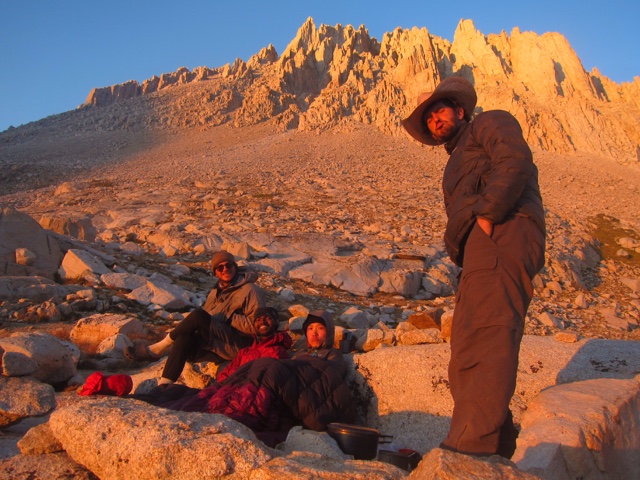
Wow, was it cold this morning. After waking up and eating breakfast, we packed up quickly and found this scenic sunspot to warm our bones. We had a short eight mile hike to Guitar Lake today,  the last viable campsite before the five mile hike to the 14,505 foot-high Mount Whitney summit. 

We stopped at this lovely meadow and looked for bears. We only saw deer but were able to enjoy the incredible peace of the far mountain range. Steady hiker traffic, the most of the entire trip, including one group of twelve elder hikers, passed us as we rested, and jumped!

Views of Mount Whitney finally came into view at Timberline Lake, a quaint lake where camping was unfortunately forbidden. We passed a group of twenty Taiwanese hikers. 

The summit of Mount Whitney looked heavily defended when viewed from below. We were going to wake up tomorrow at 230am and hike up to the summit for sunrise-on-the-top-of-the-world*. The thought of this dark task was a bit foreboding. 

We made it to Guitar Lake by lunchtime and looked for an unexposed campsite amid the treeless, 11,500 foot high terrain. We found a great campsite with large boulders on three sides and a foot tall wall of stacked rocks on the fourth side, located just above Guitar Lake at the last water before Whitney. The view of the guitar-shaped lake and the mountain range beyond was epic, truly epic. 

We met three super-cool hikers at Guitar Lake: accountant/climber Sky and programmer/adventurer Meresh from San Francisco and musician Jess from Montana. We passed the lazy afternoon by swimming in the ice cold tarn, journaling, eating as much remaining food as possible to cut weight, and exchanging stories. We ate dinner as a group as the sun went down. 

Jess played his soulful folk music as the sun slowly faded on our last night in the High Sierra. Two other couples came over, hearing the sweet music, and began to dance. 

It was, in a word, perfection. 

Comments

  1. Rocky Mountain National Park wants to do something about it. In lieu with this, the National Park Service together with the. rocky mountain air

    ReplyDelete

Post a Comment

Popular posts from this blog

Day 104 - Glacier to Vancouver

The hike up Balu Pass was supposed to be fairly easy, beautiful and dotted with waterfalls, but when I talked to the park ranger and learned that Vancouver was an eight hour drive away, I decided to skip Balu and drive west.  I left behind this pretty view.  And drove many hours through pristine mountains, fewer and fewer snow-capped ones the further west I drove. Some of the valleys were flooded to make reservoirs, leaving scenic sights.  I eventually made it to Vancouver and drove right on through to Point Roberts USA, a five mile by five mile coastal land just below the 49th parallel and thus in the USA. The park ranger had suggested this as a good place to camp but being late of the Thursday night before the Fourth of July there were no spots available. I drove around instead and stopped at a forested coastal park. After ten minutes of walking I came to my first grand Pacific view with Mount Baker 60 miles east.  The San Juan Islands and Orca Islands could also b...

Day 122 - Mount Saint Helens

Mount Saint Helens is sinister and wonderful. I spent the morning at Rainier watching the end of the British Open on my phone, then drove south to Saint Helens.  I arrived at the park's northeast entrance by early afternoon.  A massive bulge of rock built up on the northeast side of the mountain before the 1980 eruption and then caused a tremendous landslide when the eruption started. I drove to the Windy Ridge at the end of the road, listened to a ranger describe before and after photos of the mountain, then hiked up to a high viewpoint.  You can see the circular ridge with a notch missing where the landslide occurred, the desert-like exposed right-side where the landslide blew away life and covered 15 miles of terrain with 150 feet of dirt and rock, the greenery that was on the lucky side of the eruption, and Spirit Lake which was covered by dirt and slime and fallen trees for years. The mountain was over a thousand feet higher before it erupted.  After taking in t...

Day 62 - Colorado National Monument

Established as a national monument early in 1911, Colorado NM is known for its high canyon "rim road" and sandstone spires of Monument Canyon.  The canyons of west Colorado are pretty--as they have more green trees and shrubs than the more famous Utah canyons. This gives them a more alive feeling, although the sandstone spires were formed many thousands of years ago by erosion.  Rim Rock road curves up the the top of the canyon cliff, goes through several round tunnels and is lined with scenic viewpoints. The best views were in he Monument Canyon section, and included in sequence, the Coke Ovens, The Kissing Couple (behind my head), and the most famous of all: Independence Monument, the tall spire in pic 3 and viewed from the side in pic 4.  The original promoter and caretaker of the park, John Otto, was the first person to climb Independence Monument and now it's a climbing right of passage. Every July 4 climbers ascend and mount an American flag at the summit. Fun! ...